
I have a photo printed on my wall.
It was taken on a Cape Town street. In it, one person is digging through a rubbish bin. A few metres away, a couple stands beside a Porsche, admiring it. Neither knows the other is in the frame. Neither knows I was there.
That photo is street photography. Not because it was taken on a street, not because it followed any particular rule, not because Cartier-Bresson would have approved. It’s street photography because it froze a moment that tells a true story about what this city looks like – who lives here, what life costs, what gets noticed and what gets ignored while someone else admires a car.
That’s what street photography is for.
And yet almost every guide you’ll find will spend the first thousand words debating definitions, listing rules, and warning you about all the ways you could get it wrong. This isn’t that guide.
What street photography actually is
The name causes more confusion than it deserves. Street photography doesn’t have to happen on a street. It doesn’t require a city, a crowd, or a particular focal length. It isn’t exclusively candid, isn’t exclusively black and white, and doesn’t demand that you own a Leica.
What it does require is this: you go out, you watch, and you photograph what life looks like when it isn’t performing for the camera.
Photography as a formal practice started capturing everyday life in the 1850s – French photographer Charles Nègre was documenting labourers, musicians, and street traders while most of his contemporaries were still in studios. The form evolved through the 20th century, most famously through Henri Cartier-Bresson, who coined the concept of “the decisive moment” – that fraction of a second when the composition, the light, and the human element all resolve into something true.
Cartier-Bresson’s idea is genuinely useful. But it’s one idea. And the way it gets cited in every street photography guide has turned it from an insight into a prescription – as if there’s only one correct kind of street photo and it always involves perfect timing and elegant geometry.
There isn’t only one correct kind. Different photographers, different stories. The decisive moment you’re waiting for might be geometric perfection. Or it might be two strangers accidentally sharing a frame in a way that says something neither of them intended.
My own working definition of street photography is simpler than most: it’s freezing time for a moment that isn’t posed or asked for. It’s showing what life looks like when people aren’t performing it. And it has the potential – often realised only years later – to be a piece of history.
Why it matters
This is the section most guides skip, which is strange, because it’s the one that answers the only question that actually matters: why bother?
Cities change faster than people realise. Buildings come down. Neighbourhoods flip. The whole character of a block shifts in five years, then shifts again. I have photographs in my archive where the backdrop – an old building, a shopfront, a piece of street art – no longer exists. The subject is still alive somewhere, probably. But the city that surrounded them in that moment is gone.
That makes those photographs historical records. Not in a museum sense – in the honest sense. They document what was actually here, what actual people looked like on an actual day, in a city that has already become something slightly different.
Governments commission official records. Architects document buildings. Museums preserve the significant. Street photographers document everything else – the bin digger, the Porsche couple, the kid looking back over her shoulder, the man sleeping under a freeway overpass while the city hums past him. The moments that don’t get commemorated any other way.
That’s why it matters. And in Cape Town specifically, it matters more than most places – because this city is moving fast, and what it’s leaving behind is worth looking at.
Cape Town as a street photography city
I’m biased. Cape Town is my city and I’ve been photographing it for years. But bias doesn’t make me wrong.
Cape Town gives you something you can’t manufacture: the collision of a past that hasn’t been fully processed and a present that’s moving very fast. Walk off Long Street into Green Market Square and you’re in a completely different world – different energy, different faces, different light, different stories. That transition takes about sixty seconds. No two streets are the same, which means you’re never done.
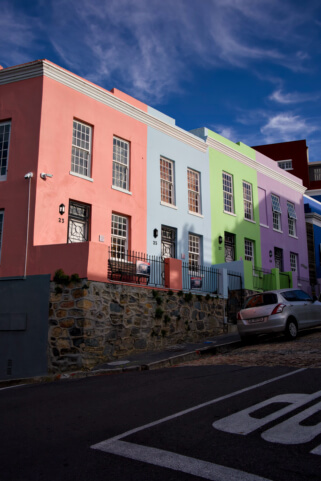
Bo-Kaap in the early morning is where I keep returning. The painted houses are the obvious draw but they’re not what I’m there for. It’s the light at 7am hitting the cobblestones, the residents starting their day with the mountain behind them, the way the neighbourhood holds its own tempo against the city that’s waking up around it. I’ve been to that street forty-something times. I’ve come away with nothing from more than half of them. The other half made it worth it.
Woodstock gives you something different – murals and gentrification in the same frame, the old and the incoming side by side, a neighbourhood still visibly figuring out what it’s becoming. The visual tension there is real and you don’t have to manufacture it. You just have to show up and see.
The city is also set against Table Mountain in a way that means your background is never neutral. You’re always shooting against one of the most recognisable backdrops on earth. Most of the time that backdrop stays out of the frame – you’re close to people, watching details, not landscapes. But occasionally a composition lands where the mountain completes the story. When it does, you’ve got something no other city can offer.

There’s also something harder to describe, which is the optimism that sits alongside the difficulty here. Cape Town is a complicated city with real problems. But there’s an energy on the streets in the morning as it comes alive – a specific kind of forward momentum – that I haven’t found anywhere else. It translates into photographs differently than cities that feel heavier or more closed. People here tend to carry themselves like the day is still going to work out.
That’s worth photographing.
How to actually shoot it
Most guides will give you a numbered list of tips. I’m going to tell you what actually changed how I shoot, which is a different thing.
Stop worrying about your camera settings before the scene.
I used to shoot full manual. I missed shots because I was still adjusting when the moment moved on. Life on the street doesn’t wait for your aperture to catch up. The best change I made was switching to aperture priority with auto ISO – set it before you leave, understand roughly what conditions you’ll be in, and then put the camera down as a problem and start using it as a tool. Your photography calculator can help you work out the settings for different light conditions before you go. Mess around with it at home so you’re not messing around on the street.
Get closer than you think you should.
The most common technical error I see from people starting out is shooting from too far away and reaching for a long lens to compensate. That produces flat images – compressed, distant, removed from the scene. Street photography works when you’re in it. A 23mm or 35mm equivalent puts you close enough that the scene surrounds you. Yes, that means the person you’re photographing is close. That’s the point. The image is better for it and, more often than not, they don’t notice or don’t care.
Change your angle.
Every first shot lives at eye level. That’s fine – it’s where your eye is. But it’s also where everyone else’s shot is. Crouch down. Step back and use negative space. Shoot up. Find the line in the scene and follow it. The difference between a flat image and an interesting one is often just that someone moved.

Take the shot.
This is the one that costs people the most. There’s a moment – a fraction of a second – when you can see that something is happening, and instead of lifting the camera you freeze. You play out the confrontation that probably won’t happen. You decide it’s too late. You wait.
My advice is simple: take the shot. If someone objects, apologise and delete it. No image is worth an argument. In South Africa, photographing people in public spaces is legal without consent – shopping centres can ask you to leave, but they cannot confiscate your camera or detain you. That doesn’t mean you should be careless or aggressive. It means the legal framework isn’t the thing stopping you. The thing stopping you is something else.
Capture what you see, not what a “good” street photo is supposed to look like.
This is the whole thing, really. You’re not trying to recreate someone else’s decisive moment. You’re showing what life looks like from where you’re standing, with your eye, in your city. That’s the part no one else can replicate. See my photography work for what that looks like from Cape Town.
The fear (and what’s underneath it)
Everyone feels it. If you’ve stood on a busy pavement with a camera and felt your hands hesitate before lifting it, you’re not doing street photography wrong – you’re doing it as a human being.
The obvious explanation for the fear is confrontation. You don’t want to make someone uncomfortable. You don’t want to be challenged or accused of something. Those are real concerns and they’re worth taking seriously.
But underneath them, I think, is something closer to self-doubt. It’s not really about the subject’s reaction. It’s the question: is my eye good enough? Will this be worth anything? What if I take the shot and it’s just a mediocre photo of a stranger who now knows I was pointing a camera at them?
The honest answer is: sometimes you’ll take a mediocre photo. Most of my shots are mediocre. The ratio of something to nothing is what you’re trying to improve over time, not the guarantee of something every time.
The fear doesn’t go away, exactly. There are still moments where I hesitate. But what changed for me is that the excitement became larger than the fear. I love this city. I’ve met people I wouldn’t have met any other way. I’ve come home with images I’m genuinely proud of. And I’m excited, every time I go out, to see what’s going to happen. That excitement – that genuine anticipation – is bigger than the discomfort.
If you’re frozen on Long Street and you can see something happening in front of you: take the shot. If they say something, apologise and delete it. If something feels genuinely wrong – if something in you is uncomfortable beyond just nerves – then leave the shot. Trust that instinct. There will be another moment on another street on another day.
The streets are patient. They’ll be there tomorrow.
Respect comes first
This matters and it’s not optional.
If someone tells you they don’t want their photograph taken: apologise, delete the image, and move on. No shot is worth a confrontation and no image is more important than the person in it. This applies even if you’re within your legal rights, which in South Africa’s public spaces you generally are.
Photographing children requires more care. If you can see a guardian or parent, ask first. If you can’t, compose your shot so the child’s face is not the subject, or leave the shot. This is a line worth holding.
Be thoughtful about photographing people in difficult situations – people who are homeless, people who are clearly in distress, people in circumstances they didn’t choose. Ask yourself whether you’d want to be photographed in the same situation. If the answer is no, read that.
Street photography documents life. It should be done with enough respect for the people in it that you’d be willing to show them the image.
FAQ
Do you need permission to photograph strangers in South Africa?
In South Africa, you have the right to photograph people in public spaces without their consent. This applies to streets, parks, markets, and most public areas. Shopping centres and private properties operate differently – they can ask you not to photograph or request that you leave, but they cannot confiscate your camera or detain you. As a general rule, if you’re in a publicly accessible outdoor space, you’re on solid legal ground. That said, legal permission and respectful practice aren’t the same thing – always be prepared to apologise and delete if someone objects.
What camera is best for street photography?
The best camera is the one you’ll actually carry. That said, smaller is usually better for street work – a smaller body is less intimidating to subjects and easier to move with quickly. I shoot with a FujiFilm, and Fuji’s X-series cameras are genuinely well-suited to street photography: compact, fast, and excellent in mixed light. If you’re starting out, your phone camera is a legitimate tool. The focal length matters more than the body – something in the 23-35mm equivalent range puts you in the scene rather than observing it from a distance.
What’s the difference between street photography and candid photography?
Candid photography is photography taken without the subject’s awareness, across any context – weddings, events, portraits. Street photography is candid photography in public spaces, with a specific focus on everyday life. All street photography is (usually) candid, but not all candid photography is street photography. The distinction matters less than the practice – the key is that the moment isn’t posed, directed, or manufactured.
Can you do street photography at night?
Yes, and night shooting produces some of the most interesting street work – artificial light sources, long shadows, a different kind of energy on the street. The technical challenge is managing noise in lower light conditions. Raise your ISO, accept some grain (it often suits the aesthetic anyway), and shoot somewhere with enough ambient light to work with. In Cape Town, Long Street at night offers a completely different set of stories to the same street at 7am. Both are worth shooting.
Is street photography considered art?
The serious answer is yes – street photography has been exhibited in major galleries, collected by institutions, and produced some of the most widely recognised images of the 20th century. Cartier-Bresson is in the Louvre. Vivian Maier’s work, discovered posthumously, now sells for significant sums. The more useful question is whether a specific photograph says something true – about a person, a place, a moment. The ones that do are art. The ones that don’t are documents. Most street photography is somewhere in between, which is fine. The practice is worth doing regardless of how the results get classified.
Where to from here
I came back to street photography after a break. I had moved out of the CBD, getting to the city was harder, and I had let doubt talk me into stopping.
What brought me back was remembering what it felt like to go out and not know what I was going to find. The uncertainty that felt like anxiety at first, and then started to feel like anticipation. The difference between the two is whether you trust that something worth photographing exists out there. After enough time on the streets, you know it does.
Cape Town’s streets are full of stories that won’t exist next year. Buildings are coming down. Neighbourhoods are changing. The specific version of this city that exists right now – today, this June – is going to be different by this time next year. Some of those changes will be documented by journalists and architects and city planners. Most of them won’t be.
You can document them. All it takes is going outside with a camera and paying attention to what’s actually happening.
See you out there.




No comment yet, add your voice below!