Query Fan Out is AI search’s secret weapon for expanding single queries into multiple intent-driven searches. Here’s how to align your content strategy with this fundamental shift in how AI systems discover and synthesize information.
Key Insights
- Query Fan Out expands one query into 8-10 related subqueries automatically during AI search processing
- Topic clusters mirror fan-out patterns, making them essential for comprehensive coverage
- GEO differs from SEO by focusing on entity-first rather than keyword-first optimization
- Coverage beats keyword density – answering more anticipated questions matters more than repetition
- Practical optimization requires systematic mapping of entities, subqueries, and content gaps
What is Query Fan Out?
Query Fan Out is Google’s AI-driven technique that expands a single search query into multiple related subqueries to improve retrieval and answer synthesis.
Rather than processing your search as one isolated request, Google’s AI systems automatically generate 8-10 related queries in parallel. These synthetic queries span different intents, formats, and semantic angles to capture what users might be trying to accomplish beyond their exact wording.
How Google AI Mode Uses Fan-Out
The process begins with prompted expansion, where an LLM generates alternate queries from your original search. The system doesn’t create random variations—it follows structured prompts emphasizing:
- Intent diversity (comparative, exploratory, decision-making)
- Lexical variation (synonyms, paraphrasing)
- Entity-based reformulations (specific brands, features, topics)
For example, if you search “best electric SUV,” Google’s fan-out might simultaneously query:
- “top rated electric crossovers”
- “EVs with longest range”
- “Rivian R1S vs Tesla Model X”
- “affordable family EVs”
- “EV SUV comparison chart 2025”
Why Fan-Out Matters in LLM-Driven Search
Query Fan Out represents a fundamental shift from exact-match keyword targeting to semantic expansion. Traditional search engines relied heavily on matching the precise words you typed. AI search systems anticipate the broader information space around your query.
This creates a crucial implication: ranking #1 for your target keyword only gives you a 25% chance of appearing in AI Overviews. Success requires ranking well across multiple subqueries that Google explores in the background.
Common Objection: “Isn’t this just keyword variation?”
Query Fan Out goes beyond synonyms or keyword variations. While traditional SEO might target “car insurance” and “auto insurance” separately, fan-out generates contextually relevant queries like “GEICO vs Progressive comparison chart for new parents”—queries that wouldn’t appear in traditional keyword research but reflect actual user intent.
Query Fan Out vs Classic SEO Keywords
Traditional SEO focused on ranking individual pages for specific keywords. Query Fan Out operates on an entirely different principle: comprehensive intent coverage across related semantic territories.
SEO Keywords vs Fan-Out vs Topic Clusters
| Approach | Focus | Coverage | Strategy | Measurement |
| SEO Keywords | Individual terms | 1-3 variants | Exact/broad match | Keyword rankings |
| Query Fan Out | Semantic expansion | 8-10+ subqueries | Intent diversity | Subquery coverage |
| Topic Clusters | Comprehensive hubs | Full topic space | Hub + spokes | Entity coverage |
The Pitfalls of Keyword-Only Strategies
Relying solely on traditional keyword targeting creates several vulnerabilities in AI search:
- Narrow retrieval scope – AI systems may not surface your content for adjacent intents
- Missed synthetic queries – Fan-out often generates queries you wouldn’t research manually
- Limited answer synthesis – AI prefers sources that address multiple facets of a topic
Micro-CTA: Future-proof your strategy by expanding beyond keywords to comprehensive topic coverage.
Topic Clusters: The Fan-Out Ally
Topic clusters provide the content architecture that naturally aligns with Query Fan Out patterns. Instead of creating isolated pages for individual keywords, clusters organize content around central themes with supporting subtopics—mirroring how AI systems expand queries.
How Clusters Mirror Fan-Out Branching
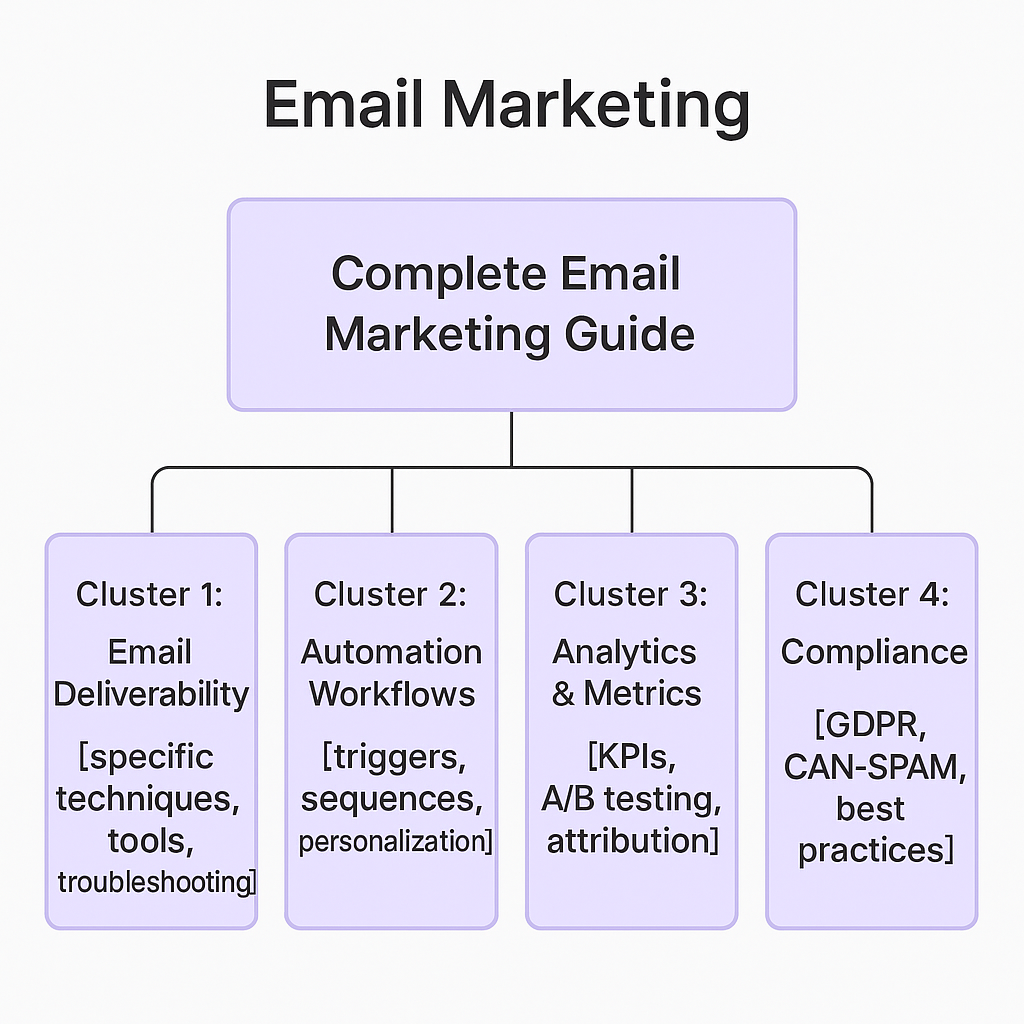
When Google’s AI encounters your pillar page about “email marketing,” it can simultaneously retrieve information for subqueries like:
- “email deliverability best practices”
- “email automation workflows”
- “email marketing metrics”
- “GDPR compliance for email”
Each cluster page becomes discoverable for its specific subquery while the internal linking reinforces topical relationships.
Query → Cluster → Subnodes Diagram
Main Query: “Email Marketing”
Case Example: How LLMs Expand Queries into Clusters
Consider a user asking “how to improve website speed.” An AI system using Query Fan Out might generate:
Primary Intent: Website performance optimization Synthetic Subqueries:
- “Core Web Vitals improvement techniques”
- “image optimization for web”
- “CDN setup guide”
- “WordPress speed optimization plugins”
- “mobile page speed best practices”
A well-structured topic cluster would have dedicated pages or sections for each subquery, all linked back to a comprehensive pillar page about website speed optimization.
PAA-Style Questions:
- Why are topic clusters important in GEO?
- How do clusters improve AI visibility?
Topic clusters improve AI visibility by providing multiple entry points for retrieval. Instead of competing for a single query, your content becomes discoverable across the entire fan-out space that AI systems explore.
GEO vs SEO: Adapting to AI Search
Generative Engine Optimization (GEO) and Search Engine Optimization (SEO) share common goals—visibility and discovery—but employ fundamentally different strategies for the AI search era.
Overlaps: Visibility and Discovery
Both approaches aim to help users find relevant information when they need it. Quality content, clear structure, and authoritative sources remain important across traditional and AI search surfaces.
Key Differences: Entity-Driven vs Keyword-First
| Aspect | SEO Approach | GEO Approach |
| Primary Focus | Keyword rankings | Entity coverage & citations |
| Content Strategy | Page-level optimization | Chunk-level optimization |
| Success Metrics | Rankings & traffic | Mentions & synthesis |
| Retrieval Model | Exact/semantic match | Multi-query expansion |
| Authority Signals | Links & domain metrics | Cite-worthiness & trust |
Hybrid Strategy Tips
- Maintain SEO foundations while adding GEO layers
- Structure content for both ranking and extraction
- Build topic clusters that serve traditional and AI search
- Monitor performance across both classic SERPs and AI platforms
- Iterate based on coverage gaps rather than just ranking changes
The future isn’t SEO vs GEO—it’s integrated optimization that performs across all discovery surfaces.
How to Align Content with Query Fan Out
Optimizing for Query Fan Out requires systematic mapping of your topic’s semantic territory and strategic content placement across anticipated subqueries.
Step 1: Map Entities + Semantic Clusters
Start by identifying your primary entity and its relationship network:
Primary Entity: Your main topic (e.g., “project management”) Related Entities: Adjacent concepts (methodology, tools, skills, roles) Attributes: Characteristics and properties (agile, remote, budget, timeline) Sub-entities: Specific implementations (Scrum, Kanban, Waterfall)
Use tools like Google’s Knowledge Graph, Wikipedia category pages, and “People Also Ask” to discover semantic relationships.
Step 2: Expand Queries Using PAA + AI Overviews
Analyze current search results to understand how AI systems are already expanding your target queries:
- Search your target keyword and note AI Overview topics
- Collect “People Also Ask” questions for secondary intents
- Query ChatGPT/Claude about your topic and analyze their question patterns
- Review competitor content that ranks for related terms
Document 15-20 anticipated subqueries that AI systems might generate from your main topic.
Step 3: Build Cluster Hubs + Spokes
Create a content architecture that addresses both primary queries and fan-out expansions:
Hub Page (Pillar): Comprehensive overview with sections covering major subqueries Spoke Pages (Clusters): Deep-dive content for specific subqueries that need extensive coverage Internal Linking: Connect spokes to hub and cross-reference related spokes
Each spoke should be optimized for its specific subquery while reinforcing the overall topical authority of your hub.
Step 4: Optimize Snippets + Schema Markup
Structure content for easy extraction by AI systems:
- Lead with clear answers (40-60 words for snippet opportunities)
- Use descriptive headings that mirror question patterns
- Include tables and lists for comparative and process content
- Add FAQ schema for commonly asked questions
- Implement Article schema to clarify content structure
Step 5: Maintain Freshness + Updates
AI systems prefer current, accurate information. Establish update cycles for:
- Quarterly content audits to identify coverage gaps
- Monthly fact-checking of statistics and examples
- Seasonal refreshes of time-sensitive information
- Ongoing monitoring of new subqueries emerging in PAA and AI platforms
Checklist: Is Your Content Fan-Out Ready?
Content Structure:
- Clear H2/H3 headings that match question patterns
- Snippet-ready answers within first 60 words of sections
- Tables/lists for comparison and process content
- Internal links to related subtopics
Entity Coverage:
- Primary entity clearly defined
- Related entities and attributes addressed
- Sub-entities covered with specific examples
- Cross-references to authoritative sources
Technical Optimization:
- FAQ schema implemented
- Article schema configured
- Clean URL structure
- Mobile-optimized experience
Tools and Frameworks for Fan-Out Optimization
Several tools can help you identify Query Fan Out patterns and optimize your content coverage systematically.
Query Fan-Out Analysis Tools
Screaming Frog + Gemini Integration Metehan Yesilyurt developed a custom JavaScript integration that analyzes pages for Query Fan Out coverage. The tool:
- Detects primary entities/topics on each page
- Predicts 8-10 subqueries likely generated by AI Mode
- Scores coverage as Yes/Partial/No for each subquery
- Suggests follow-up questions users might ask
Setup considerations: Requires Gemini API key, JavaScript rendering enabled, and careful rate limiting to avoid HTTP 429 errors.
Google Patents + AI Mode Documentation
Understanding the technical foundations helps predict how Query Fan Out will evolve:
- “Systems and methods for prompt-based query generation” details the expansion process
- Google AI Mode documentation explains implementation approaches
- Search quality evaluator guidelines reveal ranking factors for AI results
SEO Clustering Tools
Traditional tools can be adapted for fan-out analysis:
- Surfer SEO: Identifies related topics and questions
- Clearscope: Provides semantic keyword suggestions
- MarketMuse: Maps content gaps across topic clusters
Limitations + Pitfalls of Tools
Over-optimization risks: Focusing solely on fan-out coverage can harm existing rankings if not implemented carefully. Test changes on subsets of content first.
Rate limiting issues: API-based tools often encounter usage limits during large-scale analysis. Plan for incremental crawling and data collection.
False positives: Automated tools may suggest irrelevant subqueries. Human review remains essential for filtering and prioritizing recommendations.
FAQs
What is Query Fan Out?
Query Fan Out is AI search’s technique for expanding single queries into 8-10 related subqueries during content retrieval, enabling more comprehensive answer synthesis.
Why does Query Fan Out matter for SEO/GEO?
Traditional SEO targets individual keywords, but AI systems retrieve content based on multiple subqueries simultaneously. Success requires coverage across the entire fan-out space, not just primary terms.
Is Query Fan Out replacing traditional SEO?
Query Fan Out represents evolution, not replacement. Traditional SEO foundations remain important, but optimization strategies must adapt to include entity coverage and semantic expansion.
How do topic clusters connect to Query Fan Out?
Topic clusters provide natural alignment with fan-out patterns. Hub-and-spoke content architectures mirror how AI systems expand queries into related subtopics and intents.
How do I optimize for Query Fan Out?
Map your topic’s entities and attributes, identify likely subqueries, create cluster content addressing each facet, optimize for snippet extraction, and maintain freshness across all content.
What tools help with Query Fan Out analysis?
Screaming Frog + Gemini integration, Google’s PAA and AI Overviews analysis, semantic SEO tools like Surfer and Clearscope, and manual query expansion through AI assistants.
Can Query Fan Out hurt my existing rankings?
Over-optimization focused solely on fan-out can disrupt existing performance. Implement changes gradually, test on content subsets, and monitor traditional rankings alongside AI visibility.
How is Query Fan Out different from keyword variations?
Keyword variations focus on synonyms and related terms. Query Fan Out generates contextually relevant intents that may not appear in traditional keyword research but reflect actual user goals.
Glossary
Query Fan Out: AI search technique that expands single queries into multiple related subqueries for comprehensive content retrieval
GEO (Generative Engine Optimization): Optimization strategies focused on visibility and citations in AI-generated answers rather than traditional search rankings
Topic Clusters: Content architecture organized around central themes (hubs) with supporting subtopics (spokes), connected through internal linking
Entity: People, places, things, or concepts that search engines can understand and categorize within knowledge graphs
Semantic Expansion: Process of identifying related concepts, synonyms, and contextual variations around core topics
LLM SEO: Search optimization specifically focused on large language model retrieval and synthesis patterns
AI Visibility: Measure of how often content appears in or influences AI-generated answers across platforms
Snippet: Short, extractable content segments optimized for featured snippet selection and AI answer synthesis
PAA (People Also Ask): Google’s related question feature that reveals common query expansions and user intents
TL;DR Summary
- Query Fan Out = AI-driven query expansion that turns single searches into 8-10 related subqueries automatically
- Topic Clusters = structural framework for capturing traffic across the entire fan-out space
- GEO vs SEO: entity-first optimization beats keyword-first approaches in AI search
- Action steps: Map entities + subqueries, build cluster content, optimize for extraction, maintain freshness
Conclusion + Next Steps
The shift from keywords to Query Fan Out represents more than a tactical change—it’s a fundamental evolution in how search systems understand and serve user intent. While traditional SEO focused on matching specific terms, AI search anticipates the broader information space around every query.
The transformation is clear: Success now requires comprehensive coverage across semantic territories rather than narrow keyword dominance. Topic clusters provide the architectural framework to align with this shift, while entity-first optimization ensures your content participates in AI answer synthesis.



No comment yet, add your voice below!