
Gartner predicts search volume will drop 25% by 2026 as AI chatbots become the new answer engines. That seismic movement means organic visibility is no longer just about ranking on Google, it’s about being included, cited, and summarized by Large Language Models (LLMs) like ChatGPT, Gemini, and Perplexity.
Enter Generative Engine Optimization (GEO): a new discipline focused on optimizing for AI-powered, generative search results. In this article, you’ll learn what GEO is, how it differs from traditional SEO, which strategies move the needle, and how to measure your GEO wins.
Table of Contents
- What Exactly Is GEO?
- GEO vs. SEO: Same Goal, New Rules
- Why GEO Matters Now
- Core GEO Techniques
- Research: What LLMs Value
- Content: Build Answerable Chunks
- Structure: Make It Easy to Extract
- Distribution: Where GEO Links Come From
- Authority: EEAT + Backlink Quality
- Content: Build Answerable Chunks
- Structure: Make It Easy to Extract
- Distribution: Where GEO Links Come From
- Authority: EEAT + Backlink Quality
- Risks & Ethical Considerations
- Measuring GEO Success
- Future Outlook
What Exactly Is GEO?
Generative Engine Optimization (GEO) refers to the set of content strategies and technical practices that increase your chances of being cited, quoted, or surfaced in AI-generated search summaries.
Unlike traditional SEO, which optimizes for URL rankings on SERPs, GEO targets chunk-level retrieval and citation in synthesized answers. Think of it as optimizing not just your site, but your site’s presence in an LLM’s knowledge graph.
Key elements of GEO include:
- Chunk-structured content with standalone value
- Clear authoritativeness and up-to-date timestamps
- Schema-enhanced data and FAQ structures
- Entity and brand linking through anchor text
- Targeting AI search engines like ChatGPT, Gemini, Perplexity
GEO vs. SEO: Same Goal, New Rules
| Feature | Traditional SEO | Generative SEO (GEO) |
| Target | Ranked blue links in Google | LLM citations in AI Overviews & summaries |
| Engines | Google, Bing, Yahoo | ChatGPT, Gemini, Perplexity, Claude |
| Optimization Level | Page-level ranking | Chunk-level citation |
| Ranking Signals | Links, keywords, Core Web Vitals | Trustworthiness, schema, answerability, recency |
| Format | HTML pages | Passages, lists, tables, schemas |
| Output | User clicks into site | Summary answer with or without click |
Rather than replacing SEO, GEO builds on its foundations and adjusts tactics for an LLM-driven retrieval model.
Why GEO Matters Now
1. AI Search Is Growing—Fast
Platforms like Google’s AI Overviews and Perplexity.ai are now defaulting to LLM-generated summaries. According to Search Engine Land, over 25% of queries in key verticals already trigger these answers.
2. The AI Overviews Effect on Traffic
Recent internal analysis comparing Q2 2025 with the same quarter in 2024 reveals that AI Overviews are significantly reshaping organic traffic patterns. Here’s what we found:
- A notable traffic drop occurred on pages previously ranking in the top 5, especially in industries like healthcare, finance, and tech.
- CTR (Click-through rate) declined even when rankings held steady, signaling users are getting answers directly from AI summaries.
- Keywords that saw impression growth still experienced traffic loss, showing that being seen in AI Overviews does not guarantee a visit.
- Pages with position growth or stability often saw no increase in traffic—illustrating how AI snippets now siphon off clicks.
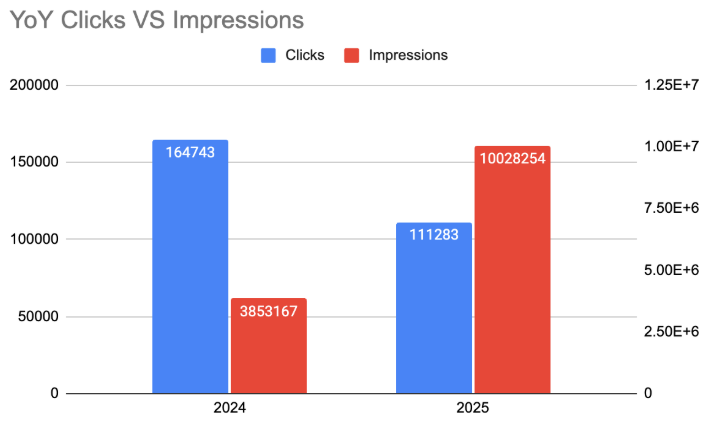
Implication: Optimizing solely for traditional SEO rankings is no longer sufficient. GEO becomes crucial to maintain presence in search visibility even when blue link traffic declines.
Action Tip: Audit top-performing content for AI Overviews inclusion. If impressions are up but traffic is down, your content may be getting paraphrased instead of cited.
3. GEO Drives Higher-Intent Traffic
Studies show LLM-cited content earns more engaged visits and converts higher than generic organic clicks. When users trust the summary, they trust the source.
4. Organic Clicks Are Shrinking
Even top-ranked content is losing visibility to summary boxes. Brands that optimize for both GEO and SEO preserve visibility across formats.
Core GEO Techniques
Generative Engine Optimization involves a combination of technical SEO, content strategy, link-building, and semantic structuring tailored for LLMs. Below we break down each component in detail, with concrete examples and best practices drawn from the latest GEO research.
Research: What LLMs Value
Large Language Models are trained on vast corpora and learn to trust and cite content that exhibits certain traits. Based on multiple citation likelihood studies:
- Entity-first backlinks: According to the “Backlink Profile Characteristics” study, LLMs strongly favor domains with 20–40% of backlinks using the brand name (e.g., “Fleetio”) or brand + keyword combinations (e.g., “Fleetio fleet software”). This forms a strong entity signal.
- Moderate authority suffices: Sites with Domain Ratings (DR) in the high 20s or low 30s are often cited, especially if they have ≈300 referring domains and thousands of backlinks. You don’t need elite DR scores.
- Balanced link distribution: 50/50 split between homepage and internal links signals topical breadth and central authority.
Example: A glossary-style page from a DR 28 site with 400 referring domains and 30% brand anchor usage is more likely to be cited than a DR 60 site with scattered links and no entity anchors.
Content: Build Answerable Chunks
AI search agents extract information from chunks or passages—not entire pages. Each H2 or H3 section should:
- Focus on one discrete concept (e.g., “What is XYZ?”)
- Include structured summaries or definitions
- Support statements with links to original research, stats, and publication dates
Best Practice: Follow a Q&A format or start with a bolded TL;DR summary.
Example: Instead of “Our analytics tool offers insights,” write: What is predictive analytics?
Predictive analytics uses historical data and machine learning to forecast future outcomes. It is often used in marketing, finance, and logistics.
This is the kind of passage LLMs love to quote.
Structure: Make It Easy to Extract
In GEO, structure means how your content is organized and encoded so that it can be easily understood, extracted, and cited by large language models (LLMs). This goes beyond visual layout—it’s about how clearly your page is segmented, semantically labeled, and machine-readable.
HTML Structure
Search engines and LLMs rely on semantic HTML to interpret and parse web pages. Use proper headings (<h1> to <h3>), section elements (<section>, <article>), and list elements (<ul>, <ol>, <li>) to divide your content into logical, standalone chunks.
Why it matters: Pages with semantically correct HTML are easier for crawlers to segment into discrete knowledge chunks—key for citation in LLMs like ChatGPT and Gemini.
Schema Markup
Schema.org markup adds machine-readable metadata to your content. GEO-critical types include:
- FAQPage – for Q&A sections
- HowTo – for step-by-step guides
- Dataset – for data-driven content
- Speakable – for voice search optimization
- Article – with author, datePublished, and headline
Example:
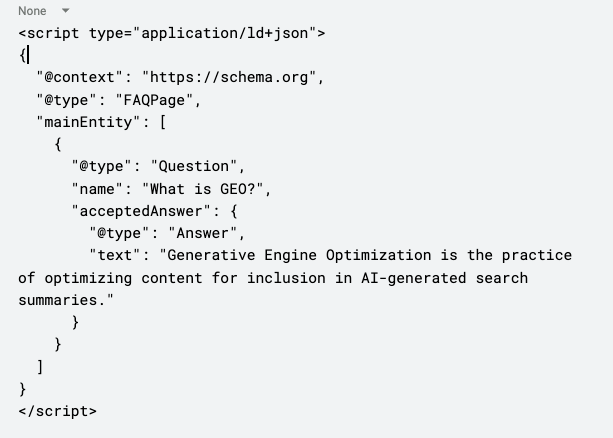
This helps AI tools like Perplexity or Gemini confidently extract facts and definitions.
Content Chunking
Structure also includes how content is chunked. Each H2 or H3 section should cover one idea or question. Keep passages <300 words. Include bolded summaries, bullet points, and sub-lists to increase extractability.
Avoid JavaScript-Only Content
Many LLMs and even major search bots struggle to crawl or render content embedded via JavaScript. This means:
- Avoid hiding key content behind tabs or accordions powered by JS
- Don’t rely solely on JS frameworks for main content delivery (e.g., SPA with lazy rendering)
Pro Tip: Use server-side rendering (SSR) or prerendered HTML for high-value content.
Example Pitfall: A page that dynamically loads definitions via React after page load may appear empty or irrelevant to an LLM crawler, even if it’s visually rich to the user.
Why it works: Structured content with clear HTML tags and schema markup lets models identify and cite exactly the answer passage needed, increasing your chances of inclusion in AI summaries.
LLMs favor semantic clarity and schema-rich formatting. Key tactics include:
- Adding FAQPage, HowTo, Dataset, or Speakable schema
- Using real HTML lists, tables, and <figure> tags with alt text
- Keeping content under 300 words per section
Example: Convert your blog’s “Tips” section into a bulleted list with <ul> and <li> elements, wrap in a semantic <section>, and link to relevant glossary pages.
Why it works: This increases crawlability and helps AI retrieve the right passage during synthesis.
Distribution: Where GEO Links Come From
Authority in GEO isn’t just about backlinks—it’s about where those links originate:
- Prioritize top-level blog pages, which are more frequently crawled
- Target roundups like “Top 10 software for freelancers”—these appear often in LLM training data
- Leverage Reddit, Hacker News, and public communities. Sentiment and discussion on these platforms have been shown to affect LLM perceptions.
Example: A Perplexity-cited source gained traction after being shared in a Reddit thread that reached r/dataisbeautiful’s front page.
Tip: Create a list of target blogs or newsletters where AI trainers likely crawl (e.g., TechRadar, MakeUseOf, industry-specific forums).
Authority: EEAT + Backlink Quality
Earning citations from LLMs requires reinforcing your brand’s expertise, experience, authority, and trust (EEAT):
- Publish original research, surveys, or unique data
- Ensure over 90% of backlinks are do-follow, with minimal “sponsored” or “UGC” flags
- Refresh cornerstone pages at least annually
Example: A vendor glossary page with only 12 backlinks but hosted on a trusted research domain was repeatedly cited in ChatGPT and Gemini due to topical alignment and schema use.
Checklist to build GEO authority:
- ✅ 300+ referring domains
- ✅ 20%+ brand anchor text
- ✅ Mix of glossary, “What is…”, and FAQ pages
- ✅ 90%+ do-follow backlinks
- ✅ Topical cluster linking (e.g., linking “fleet analytics” to “fleet tracking” to “GPS tools”)
These combined strategies elevate your visibility in generative search environments like Google’s AI Overviews, ChatGPT answers, and Perplexity summaries. Research: What LLMs Value LLMs favor:
- Branded anchor text (20–40% of backlink anchors)
- Pages with FAQ schema, concise definitions, or authoritative listicles
- Moderate domain authority (DR 28–35) with clean link profiles
- Balanced homepage and internal page links
Content: Build Answerable Chunks
Each H2/H3 section should answer one discrete user question. Include:
- Definitions
- Comparisons
- Structured lists
- Citations with author/date/schema
Structure: Make It Easy to Extract
LLMs prefer:
- FAQs and TL;DRs
- Schema like FAQPage, HowTo, Speakable
- Alt-text for visuals and real <table> markup
Distribution: Where GEO Links Come From
- Pitch to listicle editors and vendor round-ups
- Target high-crawl surfaces like blog homepages
- Earn links from relevant forums, Reddit threads, and newsletters
Authority: EEAT + Backlink Quality
- Use brand-name anchors in 25%+ of backlinks
- Maintain a clean, do-follow profile
- Create glossary-style explainer pages
Quick-Start GEO Checklist
- Audit which keywords trigger AI Overviews or Perplexity answers
- Check if your brand appears in any current AI citations
- Convert top FAQs into FAQPage schema
- Add timestamps and authorship markup to high-value pages
- Ensure chunk structure (H2 for each idea; max 300 words)
- Earn a few .edu or .gov backlinks for authority
- Include brand + topic in anchor text during outreach
- Whitelist GPTBot, PerplexityBot, ClaudeBot in robots.txt
- Use HubSpot’s AI Search Grader to benchmark
- Refresh cornerstone GEO content quarterly
Risks & Ethical Considerations
While GEO offers a tactical edge, it also presents new ethical questions:
- Hallucinated citations may misrepresent your brand
- LLMs may downrank smaller brands without enough crawl signals
- Lack of disclosure around AI-generated content poses trust issues
To mitigate these, brands should:
- Add “About this page” disclosures
- Encourage accurate citations through branded anchors
- Submit hallucination feedback to AI platforms
Measuring GEO Success
Proxy KPIs to Track:
- Citation share in Perplexity.ai and Google AI Overviews
- Referral traffic from generative engines (look for /ref=ai)
- Passage impressions in GSC (limited support, monitor for updates)
- HubSpot’s AI Search Grader score
Consider adding UTM tracking on AI-intended anchor links.
Future Outlook
- Multimodal retrieval (voice/image) is coming—optimize for alt-text and captions
- Entity-first linking will dominate citation graphs
- Regulatory guidance around AI disclosure and data usage will become standard
As AI reshapes search, GEO becomes indispensable. The brands that adapt now will define tomorrow’s visibility.



No comment yet, add your voice below!